
Find New York Recent Arrests Online
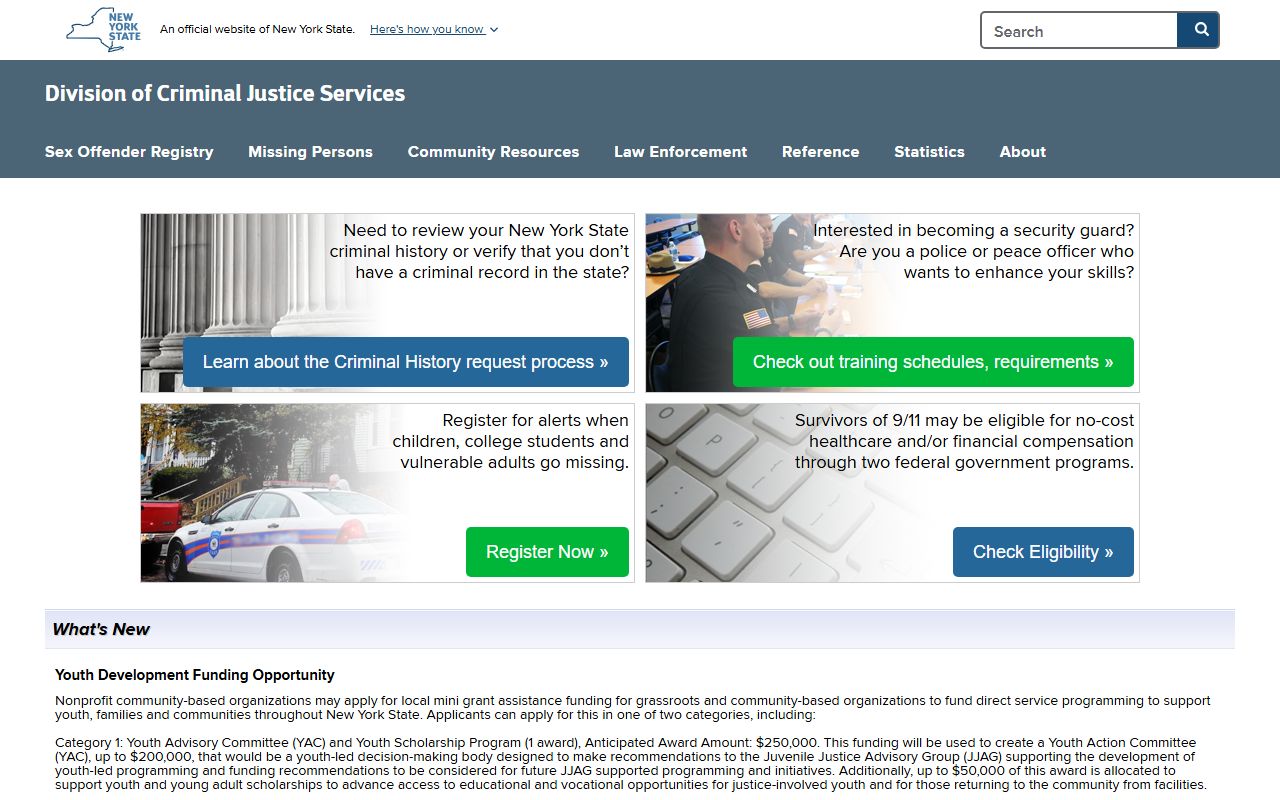
New York recent arrests are public records held by courts, sheriff's offices, and law enforcement agencies across the state. The Division of Criminal Justice Services tracks all arrest data at the state level through its Computerized Criminal History system. Each of the 62 counties runs its own sheriff's office and court system that logs bookings, charges, and case filings. You can search for recent arrests online using free tools like WebCrims and the DOCCS inmate lookup. These systems show charges, court dates, custody status, and more. For a full criminal history, DCJS requires a fingerprint submission. This page covers how to find recent arrests in New York, what tools are free, and where to look for records by county or city.
New York Recent Arrests Overview
Where to Find New York Recent Arrests
Several agencies handle arrest records in New York. The main one is the Division of Criminal Justice Services, known as DCJS. They run the Computerized Criminal History system, which is the state's official database for arrest and conviction data. Every arrest in New York gets reported to DCJS through fingerprint submissions. The State Identification Bureau processes these transactions around the clock, 365 days a year. Average processing time for an arrest transaction is under 15 minutes. Criminal history reports go back electronically to the submitting agency, district attorneys, and courts. The bureau is accredited by the ANSI National Accreditation Board and operates from the Alfred E. Smith State Office Building at 80 South Swan Street in Albany.
At the county level, sheriff's offices keep their own arrest logs and booking records. Many post recent arrests online through inmate rosters. The county clerk's office holds court records tied to those arrests. In New York City, the NYPD handles arrests for all five boroughs with 77 precincts across the city.
The Office of Court Administration runs the court side. Their Criminal History Record Search pulls conviction records for $95 per name. That fee went up from the previous $65 rate. The eCourts portal gives free access to pending criminal cases. State prisons fall under DOCCS. Their inmate lookup tool shows who is in state custody right now and has records going back to the early 1970s.
How to Search Arrest Records Online
Start with WebCrims. This is the state's online tool for pending criminal cases. It covers all criminal courts in New York City, Nassau and Suffolk counties, Erie County, and courts in the 9th Judicial District including Westchester, Rockland, Orange, Putnam, and Dutchess. You can search by case number or party name. Historical data varies by county. Nassau County records go back to 1979. New York City counties have data from 1986. Visit the WebCrims portal to run a search.
Search results from WebCrims show several useful details about recent arrests and case progress:
- Defendant's name, year of birth, and arrest date
- Docket number and next court appearance
- County, court part, and assigned judge
- Charge details with law code and section
- Disposition and sentence information
The DOCCS inmate lookup is also free. It shows people serving state prison sentences right now. Search by name and birth year, or use a DIN or NYSID number. The system lists facility location, custody status, admission date, and release date. It does not cover county jails. People held at the local level show up on county sheriff inmate rosters instead.
For a full rap sheet from DCJS, you need to submit fingerprints at an IdentoGo location. The fee is $17.50 for New York residents and $47.50 for those out of state. Results take 3 to 4 weeks by mail. Use service code 15464Z for suppressed records or 15465F for unsuppressed records. Contact the DCJS Records Review Unit at RecordReview@dcjs.ny.gov or call 518-457-9847 for help. Fee waiver applications are available for those who cannot pay.
Recent Arrests and the Court System
When someone is arrested in New York, the case enters the court system. The type of court depends on the charge. Town and village justice courts handle misdemeanors and violations. County courts take felonies outside New York City. In the city, Criminal Court manages misdemeanors and Supreme Court handles felonies. Arraignments happen fast, sometimes on the same day as the arrest. Each court keeps a case file with the arrest details, charges, bail info, motions, and final disposition. These records are public in most cases.
The eCourts system ties the courts together online. WebCivil Local covers local civil cases. WebCriminal shows criminal case data in participating courts. WebFamily handles Family Court cases in all 62 counties. WebHousing covers New York City housing court cases. The eCourts main page links to each tool. The eTrack service sends free email alerts when a case has activity. You can sign up to track pending criminal and civil cases without any cost.
Note: WebCrims does not show closed criminal cases. It only covers pending matters. For records of closed cases or past arrests, contact the county clerk or court where the case was heard.
New York Arrest Record Laws
The Criminal Procedure Law governs arrest records in New York. CPL Article 160 sets the rules for sealing. Under CPL 160.50, records get sealed when a criminal action ends in the defendant's favor. That covers dismissals, acquittals, and cases the DA declines to prosecute. Once sealed, the arrest record is removed from most public searches. CPL 160.55 covers noncriminal offenses like violations and infractions. CPL 160.58 allows sealing for certain drug-related convictions. CPL 160.59 lets people petition to seal older convictions after 10 years if they have no pending charges. These sections fall under Title H of the Criminal Procedure Law.
The Clean Slate Act took effect on November 16, 2024. It provides automatic sealing of eligible convictions after a set waiting period. DCJS processes the sealing once it gets a court order. Records of sex crimes and non-drug Class A felonies, including murder, are never eligible for sealing under this law.
Public Officers Law Article 6 (Sections 84 through 90) establishes the Freedom of Information Law, or FOIL. This lets you request records from state and local agencies. You can ask for reports, statements, regulations, memoranda, and more. Criminal history records are the key exception. Rap sheets can only be obtained through the DCJS fingerprint process, not through FOIL. FOIL requests to DCJS can be submitted online through the GOQrequest portal or by mail to 80 South Swan Street, Albany, NY 12210. The appeal process allows 30 days to challenge a denial in writing.
How to Get Copies of Arrest Records
There are a few ways to get arrest records in New York. The right method depends on what you need and who has it.
For a personal rap sheet, go through DCJS. Schedule a fingerprint appointment at an IdentoGo location. The Fingerprint Services page has the full process. Two types of responses are available: suppressed records, which exclude sealed cases, and unsuppressed records, which include everything. Fee waivers exist for people who cannot pay. Send the request to the Records Review Unit at 80 South Swan Street, 5th Floor, Albany, NY 12210. You can also email RecordReview@dcjs.ny.gov or call 518-457-9847 or 518-485-7675, Monday through Friday from 8 a.m. to 4 p.m.
The Office of Court Administration offers a name-based search. It costs $95 per name. Send your request to the Criminal History Record Search Unit at 25 Beaver Street, Room 940, New York, NY 10004. Email chrs@nycourts.gov for questions. Results come back the next business day. Payment must be by check or money order payable to "N.Y.S. Office of Court Administration." Each alias and each date of birth counts as a separate search with its own fee. Results are not certified and should not be confused with a Certificate of Disposition. A $20 charge applies to returned checks.
County sheriff's offices handle local arrest records. Contact the sheriff where the arrest took place. Most accept FOIL requests by mail, email, or online form. The legal response time is 5 business days under Public Officers Law Section 89(3). Copies cost about $0.25 per page. Electronic records are often free when available.
Free Recent Arrests Lookup Tools
New York offers several free tools for looking up recent arrests. No account or fee is needed for any of these.
The DOCCS inmate lookup runs 24 hours a day. It covers current and former state prison inmates going back to the 1970s. Search by name and birth year, or by DIN or NYSID number. The system shows facility, admission date, and expected release. It excludes youthful offenders and people whose convictions were set aside by a court. Information for certain non-violent offenders is removed after five years under Correction Law Section 9. Alternative access is available at the main DOCCS parolee lookup for those under community supervision.
The Sex Offender Registry lists Level 2 and Level 3 offenders by name, county, or zip code. Level 1 offenders are not on the public site by law. To check for Level 1 offenders, call 800-262-3257 on weekdays between 8 a.m. and 4 p.m. You need the person's full name plus one identifier such as an exact address, date of birth, driver's license number, or Social Security number. The registry includes photos, aliases, home and work addresses, and conviction details. Level 3 offenders must verify their address with local police every 90 days.
The Criminal Justice Statistics page has arrest data by county dating back to 1990. It covers index crimes like murder, rape, robbery, and assault, plus hate crimes, domestic violence, and pretrial release data. This data is also on the NY Open Data Portal. The State Police records page handles FOIL requests for investigation records, though some are exempt from disclosure under the law.
Browse New York Recent Arrests by County
Each of New York's 62 counties has a sheriff's office and court system that handles recent arrests. Pick a county below to find booking info, court contacts, and online search tools for arrest records in that area.
Recent Arrests in Major New York Cities
People in major New York cities can look up recent arrests through their county's sheriff's office and court system. Pick a city to find out where arrest records are kept and how to search them.